DUI Law
How Long Does a DUI Stay on Your Record in Arizona and What Does It Actually Affect?
A DUI conviction stays on your Arizona criminal record permanently, because Arizona does not expunge DUI convictions. Your MVD driving record works differently, since the standard records employers and insurers pull reach back only 39 months or five years. Courts still count a prior DUI for 84 months when sentencing a new charge, and most insurers rate your policy on the last three to five years of history.
Key Takeaways
Arizona offers no record expungement for DUI. The state's only expungement statute, A.R.S. § 36-2862, covers certain marijuana offenses.
Your criminal record and your MVD driving record run on separate clocks under separate rules.
MVD issues a 39 month uncertified record and a five year certified record, which is where the "five years" answer comes from.
One DUI conviction adds eight Arizona MVD points, the highest count the state assigns to any single violation.
A second DUI within 84 months triggers repeat offender sentencing under A.R.S. § 28-1381.
A set aside conviction under A.R.S. § 13-905 changes what your record says. Sealing under A.R.S. § 13-911 changes who can see it.
Your Criminal Record and Your Driving Record Are Not the Same Thing
Most people ask one question and mean two.
They want to know how long does DUI stay on record Arizona employers can pull. They also want to know when their driving privileges, auto insurance rates, and interlock obligations return to normal.
Courts and law enforcement hold the first record. A misdemeanor DUI conviction sits there with no expiration date.
ADOT's Motor Vehicle Division holds the second one. MVD runs its own point system and its own retention windows, and it does not follow what the court file says about a set aside.
That split explains most of the contradictory advice you find online.
How Long Each Piece of a DUI Stays Visible
Criminal conviction record
How Long It Stays Visible: Permanent unless a court seals it
Who Typically Looks: Employers, landlords, licensing boards
MVD record, uncertified request
How Long It Stays Visible: Most recent 39 months
Who Typically Looks: Insurers, some employers, you
MVD record, certified request
How Long It Stays Visible: Most recent five years
Who Typically Looks: Courts, government agencies, CDL employers
Arizona MVD points
How Long It Stays Visible: Eight points, counted for corrective action across a rolling 12 months
Who Typically Looks: MVD
Repeat offense lookback
How Long It Stays Visible: 84 months, roughly seven years
Who Typically Looks: Prosecutors and judges
Insurance rating window
How Long It Stays Visible: Usually three to five years, set by your carrier
Who Typically Looks: Auto insurers
SR22 filing requirement
How Long It Stays Visible: Three years from your reinstatement eligibility date
Who Typically Looks: MVD and your insurer
MVD also keeps extended history beyond what a routine request returns. A five year record coming back clean does not mean the state deleted anything.
Sep 17, 2026
So How Bad Is a DUI on Your Record in Practice?
That depends on what the next few years ask of you.
A first standard DUI under A.R.S. § 28-1381 is a class 1 misdemeanor. It brings a 90 day license suspension, mandatory Traffic Survival School, an ignition interlock requirement, jail time, and fines and assessments starting around $1,250.
The conviction outlasts every one of those penalties.
Real World Consequences Worth Planning For
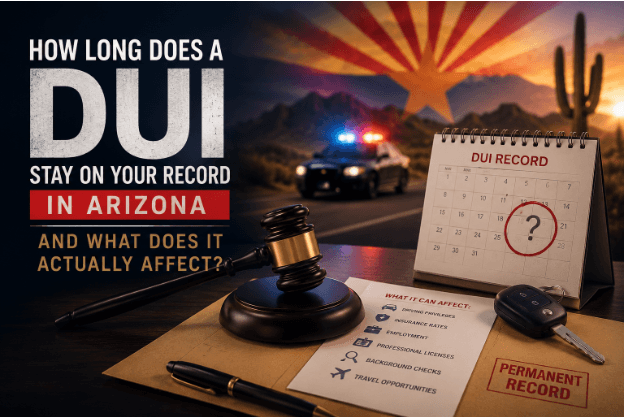
Employment screening. An Arizona background check shows a conviction, not a traffic citation. Roles involving driving, money, or vulnerable populations draw the closest scrutiny.
Professional licensing. Boards for nursing, teaching, real estate, and law ask about convictions at application and again at renewal, sometimes years after the case closes.
Housing applications. Property managers who screen criminal history see the same entry a hiring manager sees.
Auto insurance rates. Carriers move DUI drivers into high risk tiers and require an SR22 filing, which flags your status to every company you shop.
Driving privileges. You reinstate through MVD rather than the court, and letting SR22 coverage lapse can restart the three year clock.
Commercial licenses. CDL holders face separate federal disqualification rules, and a state set aside does not undo them.
What You Can Actually Do About It
Arizona gives you two tools. People mix them up constantly, and they do very different jobs.
Set Aside Under A.R.S. § 13-905
A set aside conviction deletes nothing. The judge vacates the judgment of guilt, dismisses the charge, and releases you from most penalties attached to the conviction.
Your record then shows the DUI with a set aside notation on it.
You have to finish everything first, including jail, fines, classes, probation, and interlock. The court weighs your compliance, the facts of the offense, and what you have done since.
Many petitioners also qualify for a Certificate of Second Chance, which helps with occupational licensing and gives employers some protection when they hire you.
Filing steps and eligibility details live in our guide to the Arizona record set aside process.
Sealing Under A.R.S. § 13-911
Arizona started accepting sealing petitions in January 2023. This is the option closest to what people picture when they say record expungement.
A sealed record drops out of public background checks. Law enforcement still sees it, and prosecutors can still use it to enhance a later charge.
Waiting periods start the day you complete the nonmonetary terms of your sentence. Class 1 misdemeanors wait three years. Class 2 and 3 misdemeanors wait two. Lower level felonies wait five.
One catch matters here. A later DUI blocks eligibility, even though other minor Title 28 misdemeanors do not.
Our breakdown of Arizona criminal record sealing rules walks through the classification questions that decide your waiting period.
The Timeline Most Drivers Actually Live Through
Year one is the loud one. Suspension, interlock, screening, Traffic Survival School, and your first post conviction insurance renewal all land close together.
Years two and three settle down. The interlock comes off, the SR22 stays on file, and premiums start easing.
Somewhere between years three and five, the DUI ages off routine MVD pulls and most carriers stop surcharging for it.
The criminal record is the piece that stays. That is the one worth petitioning about, and your waiting period only starts counting once your sentence is fully complete.
If your charge is still pending, defense beats cleanup every time. A dismissal or a plea to a non DUI offense avoids every timeline on this page, so talk with a DUI defense attorney in Arizona before you agree to anything.
Written and approved by: Zachary Divelbiss, Esq., founder of Future First Criminal Law and one of Arizona's most respected criminal defense attorneys. Mr. Divelbiss is an independent attorney not an employee of Legalbid.io and one of the accomplished legal professionals available on the platform to bid on your case. With 1,000+ clients represented across Maricopa County and a firm ranked among the fastest-growing in the U.S. by Law Firm 500 for four straight years, he supports Legalbid.io's mission because he believes a criminal hiccup should never become a life sentence. Learn more at futurefirst.law.