DUI Law
How To Beat a Physical Control Charge in Arizona?
To beat a physical control charge in Arizona, your defense must show the state cannot prove you posed a real danger through current or imminent control of the vehicle while impaired. Arizona courts weigh the totality of the circumstances, so key location, engine status, seat position, and where you parked all carry weight. Strong cases also challenge the point where a welfare check became a detention and attack the reliability of the field sobriety test and chemical testing.
Key Takeaways
Arizona prosecutes actual physical control under the same statute as regular DUI, A.R.S. § 28-1381.
No statute defines actual physical control. Juries apply a 13 factor test drawn from State v. Love and approved in State v. Zaragoza.
Where your key sat, whether the engine ran, and where you were seated often decide the outcome.
Your intent is not an element of the offense, so a defense built only on "I was never going to drive" will fail.
Testing and procedural errors can defeat the impairment element even when control looks obvious.
Your license is attacked on a separate track, and the deadline to request an MVD hearing is printed on the notice you were served.
What Actual Physical Control Means Under Arizona Law
Your car never has to move. A.R.S. § 28-1381 makes it unlawful to drive or be in actual physical control of a vehicle while impaired to the slightest degree, or with a blood alcohol concentration of 0.08 or higher within two hours.
Those six added words drive a large share of parked car DUI arrests outside bars in Tempe, Scottsdale, and central Phoenix.
Here is the detail most people never hear. The legislature added the phrase in 1950 and never defined it. That gap is where your defense lives, and it is worth understanding the Arizona actual physical control laws before you decide how to plead.
How Courts Decide Whether You Had Control
In State v. Love, 182 Ariz. 324 (1995), the Arizona Supreme Court scrapped rigid rules in favor of a totality approach. State v. Zaragoza, 221 Ariz. 49 (2009), confirmed that standard and wrote the instruction judges now read to juries.
The jury answers one question. Did your current or imminent control of the vehicle present a real danger to yourself or others at the time?
Thirteen factors guide that call. They include whether the vehicle was running, whether the ignition was on, where the key was, where and how officers found you sitting, whether you were awake, whether the headlights were on, where the vehicle was stopped, whether you voluntarily pulled off the road, time of day, weather, whether the heater or air conditioning was on, whether the windows were up or down, and any explanation of the circumstances shown by the evidence.
That last factor is where good defense lawyers do their work.
Why Intent Does Not Save You
Zaragoza sat in the driver's seat, put his key in the ignition, and never started the engine. He testified he only meant to sleep there and roll down a window. He lost.
DUI is a strict liability offense in Arizona. The court held that any instruction asking jurors to weigh a defendant's purpose in controlling the vehicle misstates the law.
So "I was never going to drive" is not a defense by itself. What works is evidence about the physical circumstances the officer walked up on.
17 sept 2026

When Physical Control Exists and When It Does Not
Key location
Points toward physical control: Key in the ignition or in your hand
Supports a valid defense: Key in the trunk, glove box, or a bag out of reach
Engine and ignition
Points toward physical control: Engine running or ignition switched to on
Supports a valid defense: Engine off and cold when officers arrived
Seat position
Points toward physical control: Behind the wheel with feet near the pedals
Supports a valid defense: Back seat, or reclined and asleep away from the controls
Where the car sat
Points toward physical control: Stopped in a travel lane, on a shoulder, or blocking traffic
Supports a valid defense: Legally parked in a lot or marked space, clear of moving traffic
Headlights
Points toward physical control: Headlights or running lights on
Supports a valid defense: Lights off and the car settled for the night
Conduct when roused
Points toward physical control: You reached for the gearshift or started the engine
Supports a valid defense: You stayed put and made no move toward the controls
Explanation of circumstances
Points toward physical control: Nothing accounts for why you stopped where you did
Supports a valid defense: Extreme heat, a canceled ride, or plain exhaustion accounts for it
Common Defense Strategies
No current or imminent control. Your lawyer builds the Zaragoza factors in your favor and argues the state proved presence in a car, not control of one.
Shelter from weather or exhaustion. Sleeping in your car DUI arrests can collapse when the physical evidence shows a stationary shelter rather than a vehicle ready to move.
A consensual encounter that became a detention. An officer may walk up to your parked car and talk to you without any suspicion at all. The attack targets the moment that turned into a seizure without reasonable suspicion, or a welfare check stretched past its purpose.
Flawed field sobriety test. These tests were validated on drivers stopped at the roadside, not on people shaken awake at 3 a.m. Uneven pavement, poor lighting, injuries, and grogginess all skew the scoring.
Unreliable breathalyzer results. Calibration and maintenance records, operator certification, the required observation period, and mouth alcohol all give your lawyer room to challenge the number.
Rising blood alcohol. If your last drinks were still absorbing while you slept, your concentration at the roadside may not reflect what it was earlier.
Statements taken improperly. Anything you said during custodial questioning without a warning, or after you asked for a lawyer, may be off limits at trial.
The Shelter Defense Has Real Limits
Arizona's shelter rule comes from case law, not from any statute. Zaragoza dropped the shelter language from the recommended instruction, though later decisions confirm you may still argue it.
Two traps recur. Telling an officer you pulled over because you were too drunk to drive hands the state an admission that you drove while impaired. And even when a jury accepts that you relinquished control, prosecutors can still prove you drove to that spot while over the limit.
Say little at the scene. Politely decline questions about where you had been or how much you drank.
Protect Your License on a Separate Clock
The Motor Vehicle Division moves independently of the criminal court. A test result of 0.08 or higher triggers an administrative suspension of at least 90 days under A.R.S. § 28-1385, whether or not you are ever convicted.
Refusing the test costs more. A first refusal carries a twelve month suspension under A.R.S. § 28-1321.
A timely hearing request stays the suspension until the hearing happens. Current law allows 30 days from service, though many older articles still cite 15, so treat the date printed on your own notice as the deadline.
What a Conviction Actually Costs
A first standard physical control conviction is a class 1 misdemeanor. The statute sets a minimum of 10 consecutive days in jail, and the judge may suspend all but one of those days if you complete court ordered screening, education, or treatment.
A $250 minimum fine plus two mandatory $500 assessments puts the floor near $1,250 before surcharges.
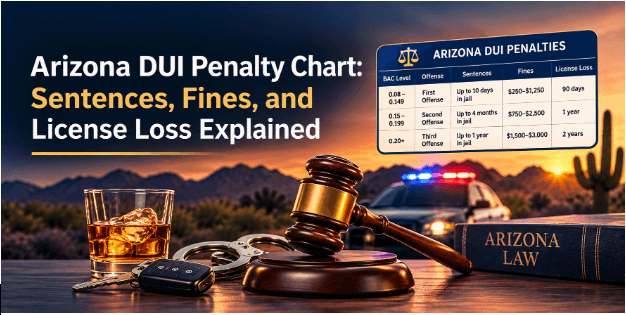
You will also carry a certified ignition interlock for at least twelve months under A.R.S. § 28-3319, reducible to six with clean compliance. Readings of 0.15 to 0.199 carry a 30 day jail minimum, and 0.20 and above carries 45 days under A.R.S. § 28-1382, which is why the full range of Arizona DUI penalties matters before you accept any plea.
Get a Defense Lawyer on It Early
Evidence fades fast. Parking lot surveillance gets overwritten within days, and body camera footage has to be requested before anyone reviews it.
A lawyer who tries physical control cases will know which factors your judge weighs most and which officers have shaky testing records. Start by learning how to choose a DUI defense attorney who takes these cases to trial.
Written and approved by: Zachary Divelbiss, Esq., founder of Future First Criminal Law and one of Arizona's most respected criminal defense attorneys. Mr. Divelbiss is an independent attorney not an employee of Legalbid.io and one of the accomplished legal professionals available on the platform to bid on your case. With 1,000+ clients represented across Maricopa County and a firm ranked among the fastest-growing in the U.S. by Law Firm 500 for four straight years, he supports Legalbid.io's mission because he believes a criminal hiccup should never become a life sentence. Learn more at futurefirst.law.